
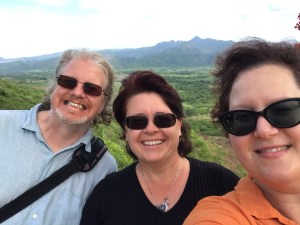
The three amigos’ final day
We waved goodbye to our host family and hopped back into the minibus to take the scenic route back to Havana, passing through Santa Clara and Cienfuegos on the way.
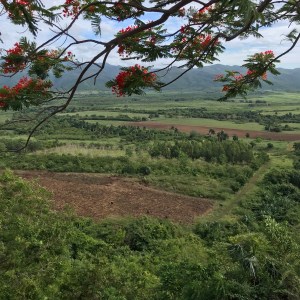
The view
Our first stop was a ‘viewing spot’ of a café on the top of a hill where we could see all the surrounding countryside and across to the sea. They apparently do ziplining there, but our party were happy to have our feet firmly on terra firma! One interesting thing we saw was that their tables and chairs were made from barrels cut and reinforced. Great idea!

R and the tower
We also stopped off at the tower. It sounds like an exercise in machismo from start to finish – it was the tallest tower in Cuba for a long time, and there is a legend about it: a local sugar plantation owner had two sons who were both in love with the same slave girl. To stop them fighting, he set them a test, that one had to dig a well and one had to build a tower, and the longest distance got the girl. (Obviously they didn’t ask her who she preferred!) The father measured them, and declared it a draw, so he married the girl himself. Then he was jealous that other men were flirting with his wife, so he locked her at the top of the tower until she died. Hmm.

See the embroidery all hung out?
The town is famous for its embroidery, so the walkway to the tower was lined with people selling embroidered tablecloths etc, and a couple of souvenir shops. We picked up a few bits and pieces, and I finally succumbed and bought a pair of red leather maracas – we’ll see if Customs lets me bring them home!

Commandante Amigo, Che
Our next stop was Santa Clara for the Che Guevera museum and mausoleum. Santa Clara is the site of one of Che’s major victories for the revolution, which is why it is the site of his remains. There were lots of pictures and mementos of his life – he certainly looked like he had his fair share of charisma, so I’m not surprised he was such an influential revolutionary.
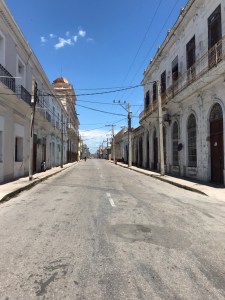
Cienfuegos
Cienfuegos is a beautiful city, well named the ‘Pearl of the south’. There are lots of gorgeous buildings from Cuba’s heyday, many turned into hotels. We took a turn around the main square and down the boulevard to the shoreline of the bay, before heading to ‘The Tip’, an area of beaches and restaurants where we stopped for a late lunch at a restaurant overlooking the water.

The final countdown of mojitos
Our 3+ hour minibus ride back to Havana was enlivened by a stop on the side of the highway to run back and take a photo of the sign saying “Australia” (signalling a town), much to the bemusement of a local leaning on the sign waiting for a lift.
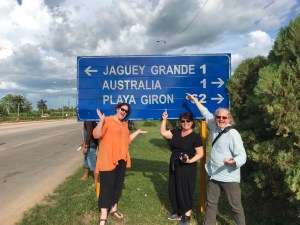
We’re that close?
As we reached the outskirts of Havana again, I started feeling distinctly unhappy in the stomach, so I was very relieved to be given our same (ground floor) room in the casa and I could crawl into bed. A torrid night ensued in all the wrong ways – motion sickness? food poisoning? traveller’s tummy? Whatever it was, it was not fun! Not a great end to our trip, but at least various medications enabled me to get to the airport and through the flight OK.

Seeing the world in a new way – Cienfuegos
The trip here has been wonderful – a real eye opener. Cuba is a country of contrasts – happiness throughout a tense history; colour and music and dance with strict organisation.
It’s amazing to see the lives people live here. It seems like we’ve gone back in time to varying extents – people out of the main towns don’t own cars, they own horses or bicycles. Horses aren’t leisure animals: they’re transportation or working animals. Transportation for most people otherwise is on the back of a truck, although the new Chinese trains starting this week will help with that. Fencing is wire twisted around sticks or trees planted along the fence line. They use shutters or wrought iron grilles instead of glass windows in their houses – this is the same in the city too. Even though the revolution was 60 years ago, people are still incredibly patriotic about it, and the heroes are household names – and their names and slogans are painted on buildings and on signs in every town.
I also have contrasting feelings. It’s not a particularly comfortable place to visit in some ways (the heat and humidity in the middle of summer were very difficult, the lack of infrastructure we’re used to means it would have been almost impossible to travel without help) but otherwise it’s an incredibly friendly and open place too, where people are happy that you’re interested in their home and want you to enjoy the place. B said at one point that one of his clients thought Cuba’s attraction was that it was like being in a time machine, and that when the barriers to the outside world are relaxed and Cuba caught up, it wouldn’t be worth visiting for a lot of people. I don’t know – I just loved that there was always music playing somewhere nearby.

An interesting welcome to the restaurant.
 Two Weeks Away
It’s interesting to read your thoughts about Cuba. Ours were similar. Actually found it quite sad. The people-10 years ago – were quite desperate. But wasn’t Che a very good looking chappie!!